Introduction
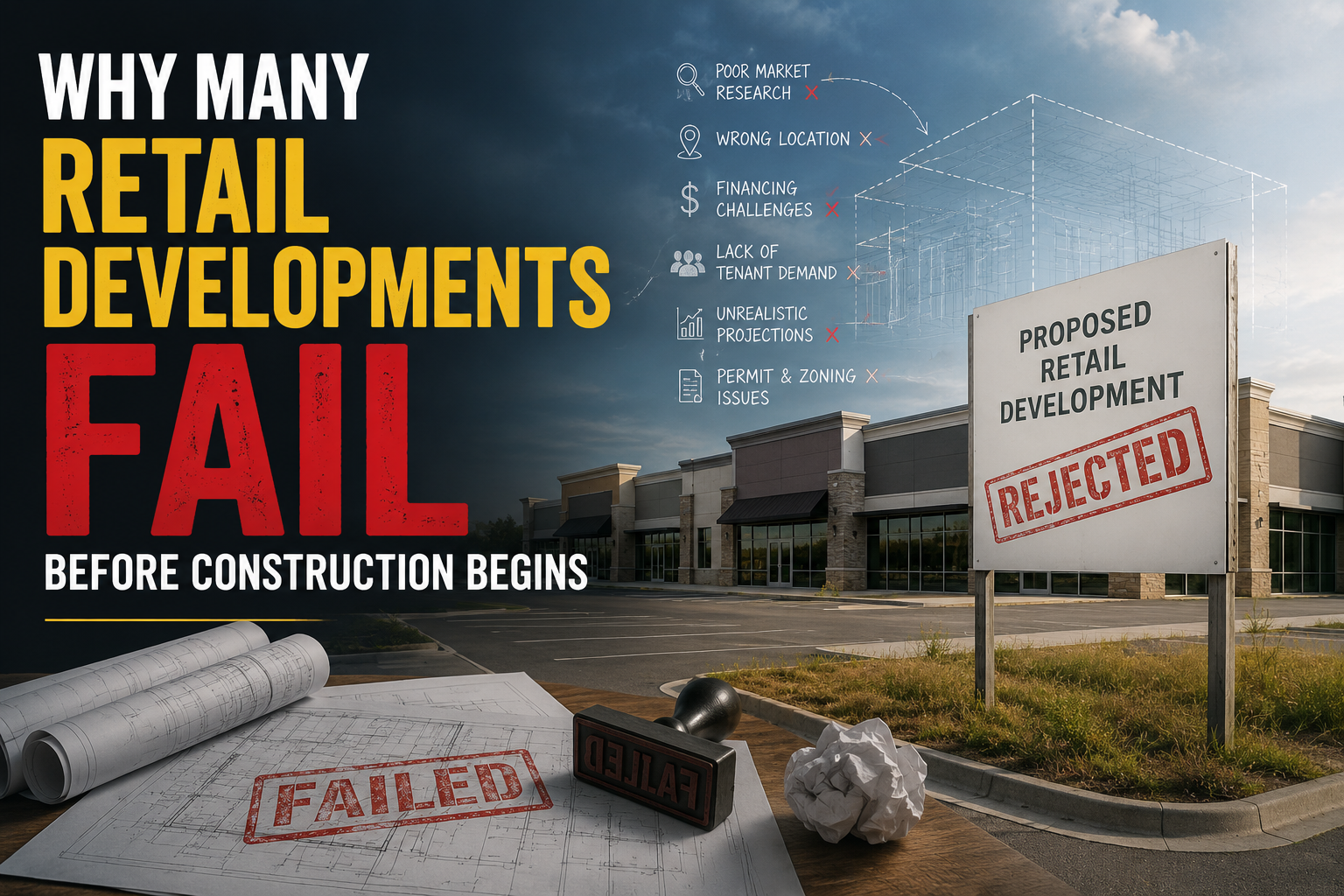
In shopping center development, most risks are not visible once construction begins — they occur long before ground is ever broken.
The pre-development phase — including land acquisition, site planning, and underwriting — is where projects are either set up for success or exposed to long-term challenges. For investors, understanding these early-stage risks is essential when evaluating development opportunities.
1. Land Selection Without True Demand Alignment
A common mistake in shopping center development is acquiring land based on projected growth rather than validated near-term demand.
Population growth alone does not guarantee retail viability.
Challenges often include:
- Overestimating consumer spending patterns
- Misjudging how quickly demand will materialize
- Assuming tenants will enter a market without proven traction
Successful projects are based on current demand signals and near-term growth, not long-term projections alone.
2. Underestimating Entitlement and Approval Risk
Zoning, permitting, and municipal approvals can significantly impact development timelines.
Delays in this phase can lead to:
- Increased holding costs
- Missed development windows
- Changes in market conditions
Each municipality has its own process, and navigating these approvals requires local expertise and careful planning.
3. Site Planning That Limits Tenant Performance
Even in strong locations, poor site design can reduce leasing potential.
Critical issues include:
- Inefficient parking and circulation
- Limited access or poor ingress/egress
- Weak visibility for key tenants
- Layouts that do not support modern tenant requirements
Shopping center tenants evaluate not just location, but how well a site functions operationally.
A well-designed center improves:
- Tenant performance
- Lease-up speed
- Long-term retention
4. Overreliance on a Single Anchor or Concept
Some developments depend too heavily on one tenant or a narrow category.
This creates risk if:
- The anchor delays or withdraws
- Market demand shifts
- Consumer behavior changes
A balanced shopping center typically includes:
- Service-oriented tenants
- Food and beverage
- Medical and wellness users
- Daily-needs retail
Diversification reduces dependency and improves long-term stability.
5. Misaligned Underwriting Assumptions
Pre-development underwriting often relies on projections related to:
- Rental rates
- Lease-up timelines
- Construction costs
- Exit pricing
Overly aggressive assumptions can make projects appear viable but difficult to execute in practice.
Disciplined underwriting focuses on:
- Realistic rent expectations
- Conservative lease-up timelines
- Accurate cost forecasting
This protects both the project and investor capital.
6. Experience and Discipline Define Outcomes
Shopping center development is not just about identifying opportunities — it is about filtering risk before execution begins.
Experienced developers emphasize:
- Precise site selection
- Demand validation
- Conservative financial modeling
- Long-term asset performance
This approach often results in fewer projects pursued, but significantly stronger outcomes.
Conclusion
Most development challenges are not construction-related — they are decision-related, occurring during the earliest stages of a project.
For shopping center investors, understanding pre-development risk is critical. Projects that are carefully evaluated, well-designed, and conservatively underwritten are more likely to perform consistently over time.
In shopping center development, success is not defined by how quickly a project moves forward — but by how well it is structured before it begins.