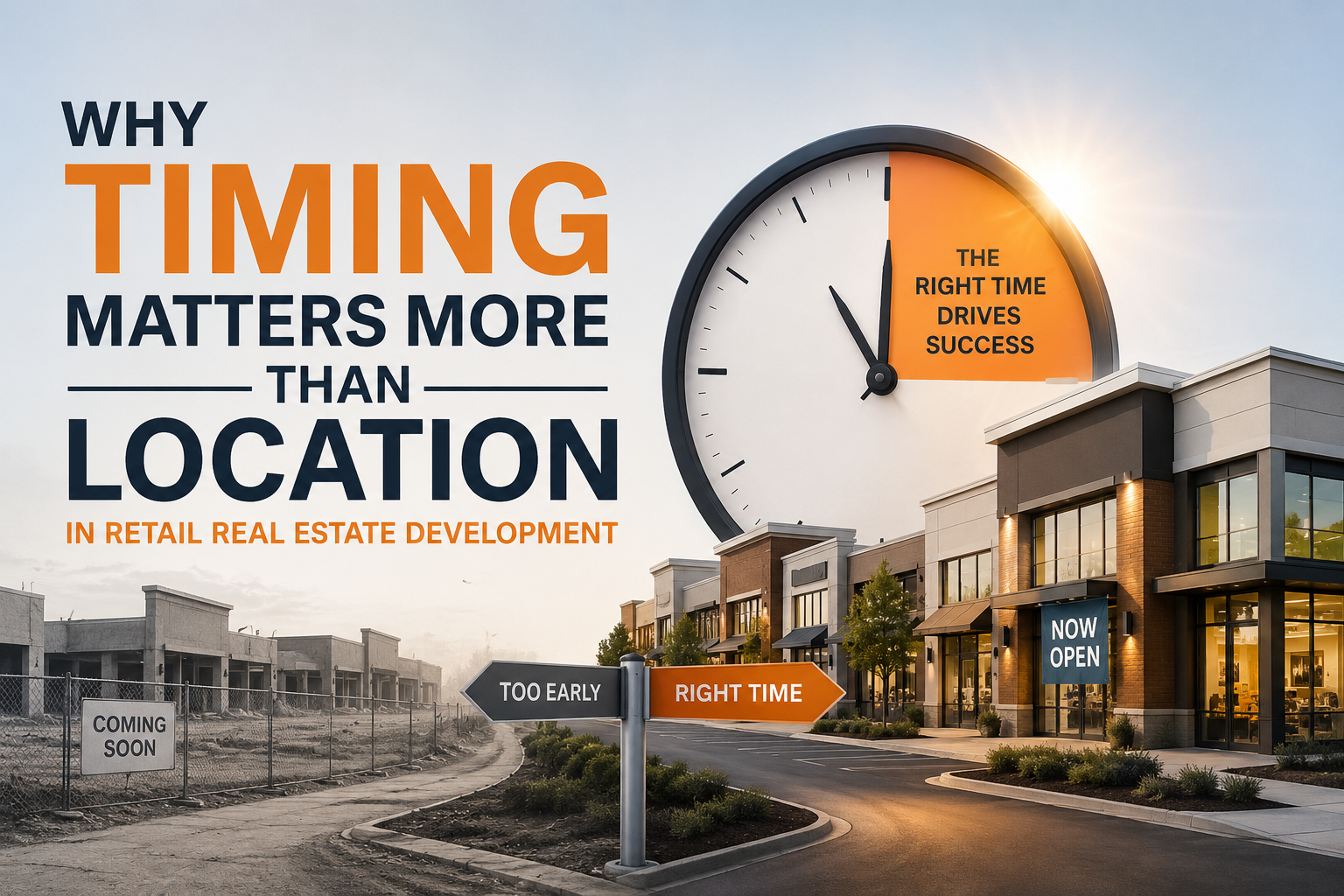
“Location, location, location” has long been the defining principle of real estate. But in shopping center development, another factor often carries equal — if not greater — weight: timing.
Even a well-located site can underperform if it is delivered too early or too late relative to surrounding growth. For investors, understanding how timing impacts leasing, construction, and capital deployment is critical to achieving consistent outcomes.
1. The Risk of Being Too Early
Developing a shopping center in a high-growth corridor before demand materializes can create significant challenges.
In early-stage areas:
- Residential density is still forming
- Traffic patterns are not fully established
- Tenant demand is not yet proven
- National and regional tenants are cautious
While the long-term fundamentals may be strong, early delivery often leads to:
- Slower lease-up
- Extended carrying costs
- Increased pressure to incentivize tenants
In many cases, the issue is not location — it’s premature timing relative to real demand.
2. The Risk of Being Too Late
Entering a market after it is fully established presents a different set of constraints.
At that stage:
- Prime corners and intersections are already taken
- Competing shopping centers are operational
- Tenant demand is more selective
- Land pricing reflects peak expectations
Late-stage development often results in:
- Higher basis with less upside
- Increased competition for tenants
- Limited ability to differentiate the asset
Even in strong submarkets, timing can compress returns if entry occurs after the primary growth cycle.
3. The “Right Window” in Shopping Center Development
The most effective developments are delivered within a specific window:
- After residential growth is clearly underway
- Before retail supply meets full demand
- When tenants are actively expanding into the submarket
This is when developers can:
- Secure stronger lease commitments
- Lease space efficiently without excessive incentives
- Capture rental growth as the area matures
- Establish long-term positioning within the corridor
Identifying this window requires more than data — it requires market experience and disciplined decision-making.
4. Timing and Capital Conditions Must Align
Development timing is not only about demand — it is also influenced by capital markets.
Key considerations include:
- Interest rate environment
- Construction cost trends
- Debt availability
- Exit liquidity
Launching a project without alignment between market demand and capital conditions can impact overall performance, even in strong locations.
Disciplined developers evaluate both on-the-ground demand and broader financial conditions before moving forward.
5. A Disciplined Approach to Execution
In shopping center development, timing is a function of discipline — not speed.
A structured approach typically includes:
- Monitoring residential delivery and absorption
- Tracking tenant expansion patterns
- Evaluating competing supply pipelines
- Understanding infrastructure and traffic growth
This approach allows developers to deliver projects that are:
- Well-timed
- Well-leased
- Positioned for long-term stability
Conclusion
Location remains a fundamental driver in real estate — but in shopping center development, timing determines how that location performs.
Projects delivered within the right phase of a market’s growth cycle tend to outperform those that rely solely on site quality. For investors, the difference often comes down to execution — understanding when demand is real, when tenants are ready, and when new supply can be absorbed.
In today’s environment, timing is not just a variable — it is a defining factor in successful shopping center development.